Three Legs. One Match Script.
Why correlation is the only thing that matters in a same game multi — and what happened when we published three of them in Round 25.
Saturday night, Allianz. Dragons v Bulldogs.
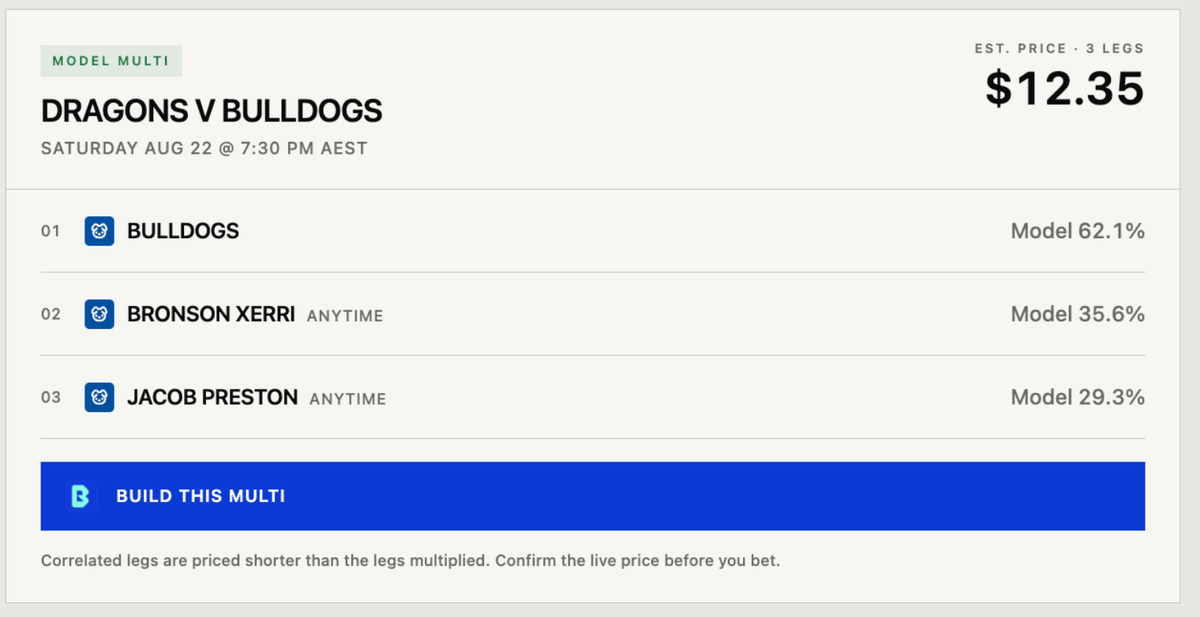
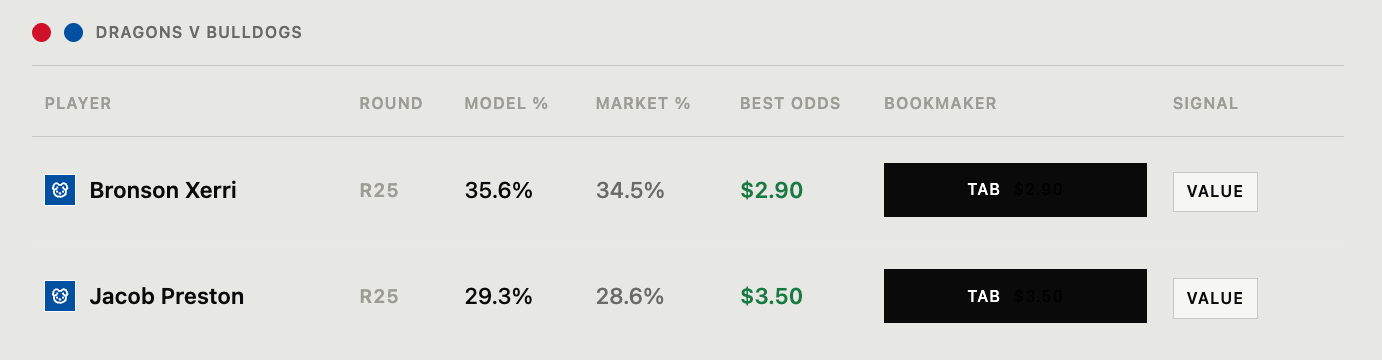
The model multi had three legs: Bulldogs to win, Bronson Xerri anytime, Jacob Preston anytime. Estimated price $12.35.
Bulldogs 44, Dragons 14. Xerri crossed. Preston crossed.
Nice number. But the number isn't the interesting part, and it isn't the reason we published it. What's interesting is that those three legs were never really three separate bets. They were one bet, described three ways.
Most same game multis aren't built that way. That's the whole problem.
Why most multis fall apart
Think about how the average SGM gets built. Ninety seconds, Friday afternoon, thumb on the app.
Take the favourite. Add a tryscorer from the other side, because he's been good lately. Add an over, because the game feels like it'll open up. Four legs, decent price, done.
Nothing there is stupid. Each leg is defensible on its own. The issue is that they describe four different football matches. The favourite winning comfortably and an underdog winger scoring twice are not the same afternoon. Only one of those games is going to be played.
Add legs and the price multiplies. It's easy to feel that part. What's harder to feel is that the number of ways the bet dies multiplies at the same time — and if the legs contradict each other, you've stacked the ways it dies without stacking the ways it lives.
What correlation actually means
Correlation is just this: some outcomes move together.
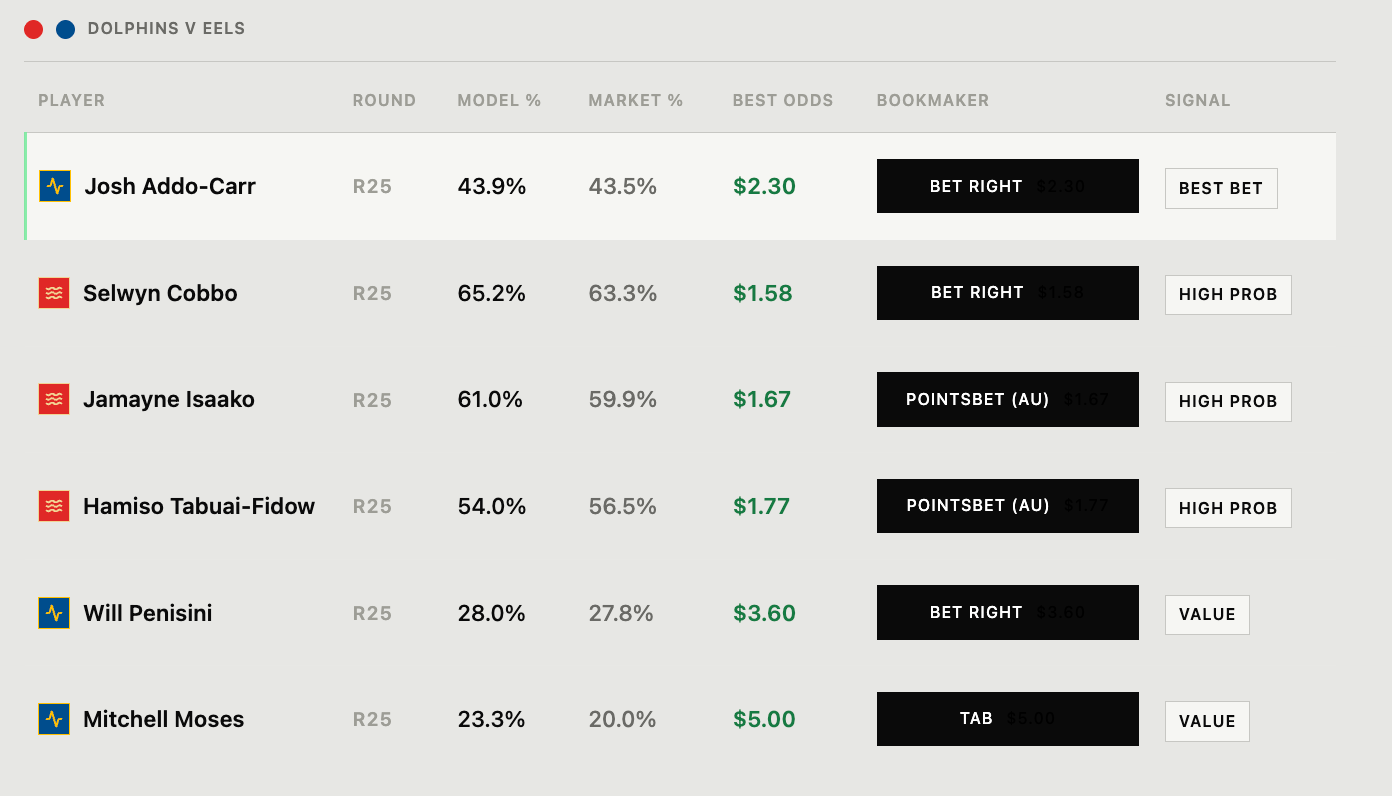
If the Dolphins win by 18, a lot of other things become more likely at the same time. Their outside backs cross. Their fullback gets involved. The margin holds. Those outcomes aren't independent — they're all downstream of the same match script.
Bookmakers know this, and they price it. A same game multi is priced shorter than the individual legs multiplied out, because the operator applies a correlation adjustment. That's standard across the industry and it's disclosed. It's why every multi we publish carries the same line: correlated legs are priced shorter than the legs multiplied, confirm the live price before you bet.
We do the same thing on our own estimates. We multiply the legs, apply a flat discount, and round down. The number you see on a RightEdge multi is deliberately conservative.
Here's the part most punters miss, though. That adjustment cuts both ways.
If you're paying a correlation discount either way, you may as well build a bet that actually uses the correlation. Legs pointed at the same match script win together. Legs pointed at different scripts get you the shortened price and none of the alignment. Same cost, worse bet.
How the model builds one
Three rules. They're boring on purpose.
Anchor on the projected winner
The first leg is whichever side the model projects to win. Not the bigger price, not the storyline, not the side that would make the multi pay more. If the model has the Bulldogs at 62.1%, the Bulldogs are the anchor.
Every other leg comes from the anchor team
All tryscorer legs are drawn from the anchor side's projected scorers. Not the opposition's in-form winger. Not a name from the other team who's been getting a run. Same side, same script, same direction.
Legs qualify on model probability, not reputation
A tryscorer leg gets in because the model rates his chance of crossing, not because you'd recognise him. Jacob Preston at 29.3% made the Bulldogs multi. Plenty of bigger names didn't make any multi at all.
The consequence of those three rules is that most matches produce nothing. Round 25 had nine games. Three of them produced a multi. That's the feature working, not failing.
Round 25 — the three multis
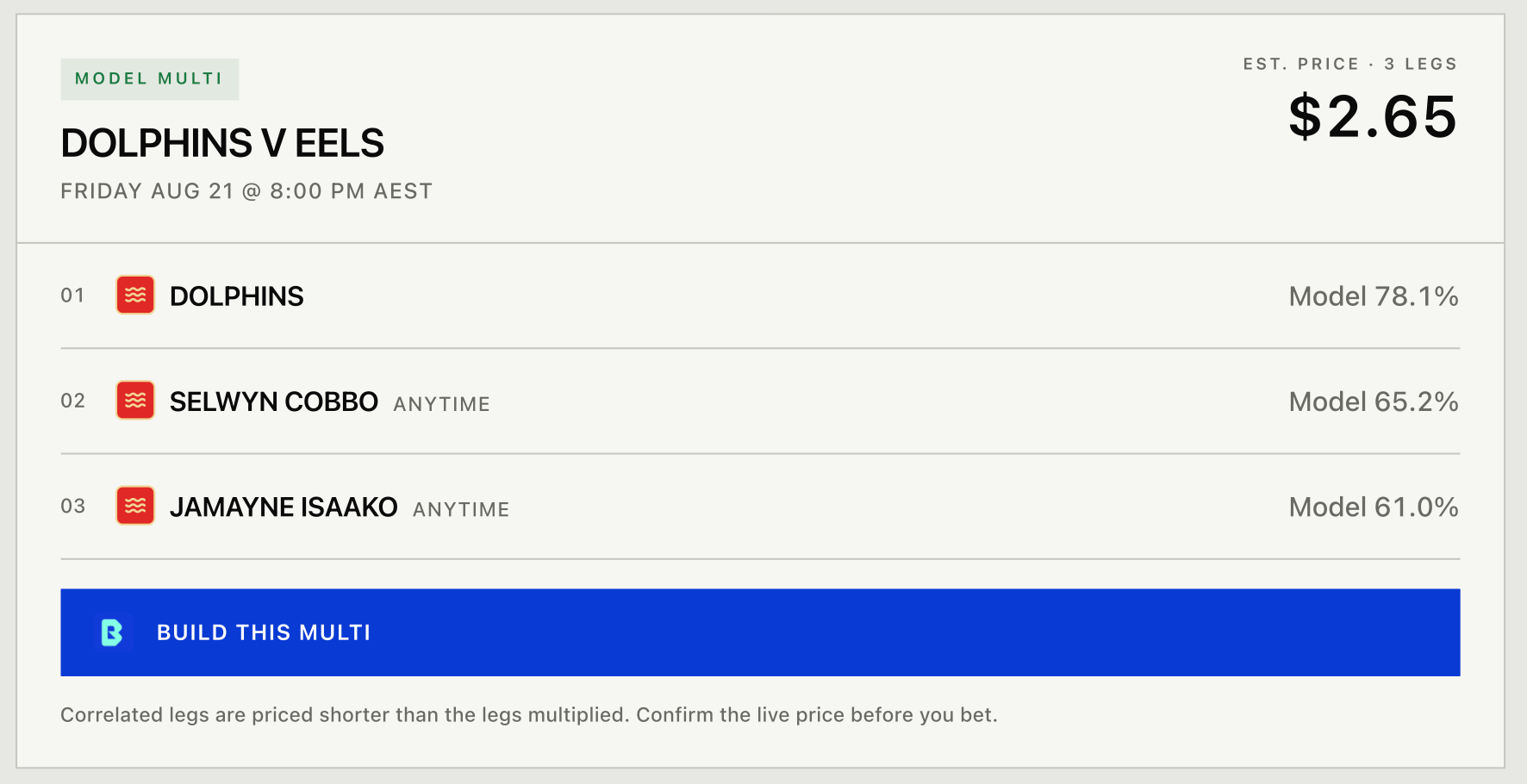
Dolphins v Eels — $2.65 est. Dolphins (model 78.1%), Selwyn Cobbo anytime (65.2%), Jamayne Isaako anytime (61.0%). Dolphins 34, Eels 16. All three legs landed.
The model read: Parramatta miss 39.4 tackles a game — the most in the competition. The Dolphins break 34.4. Those aren't two separate facts. They're one match script, and it's why both tryscorer legs came off the Dolphins' edge rather than anywhere else on the park.
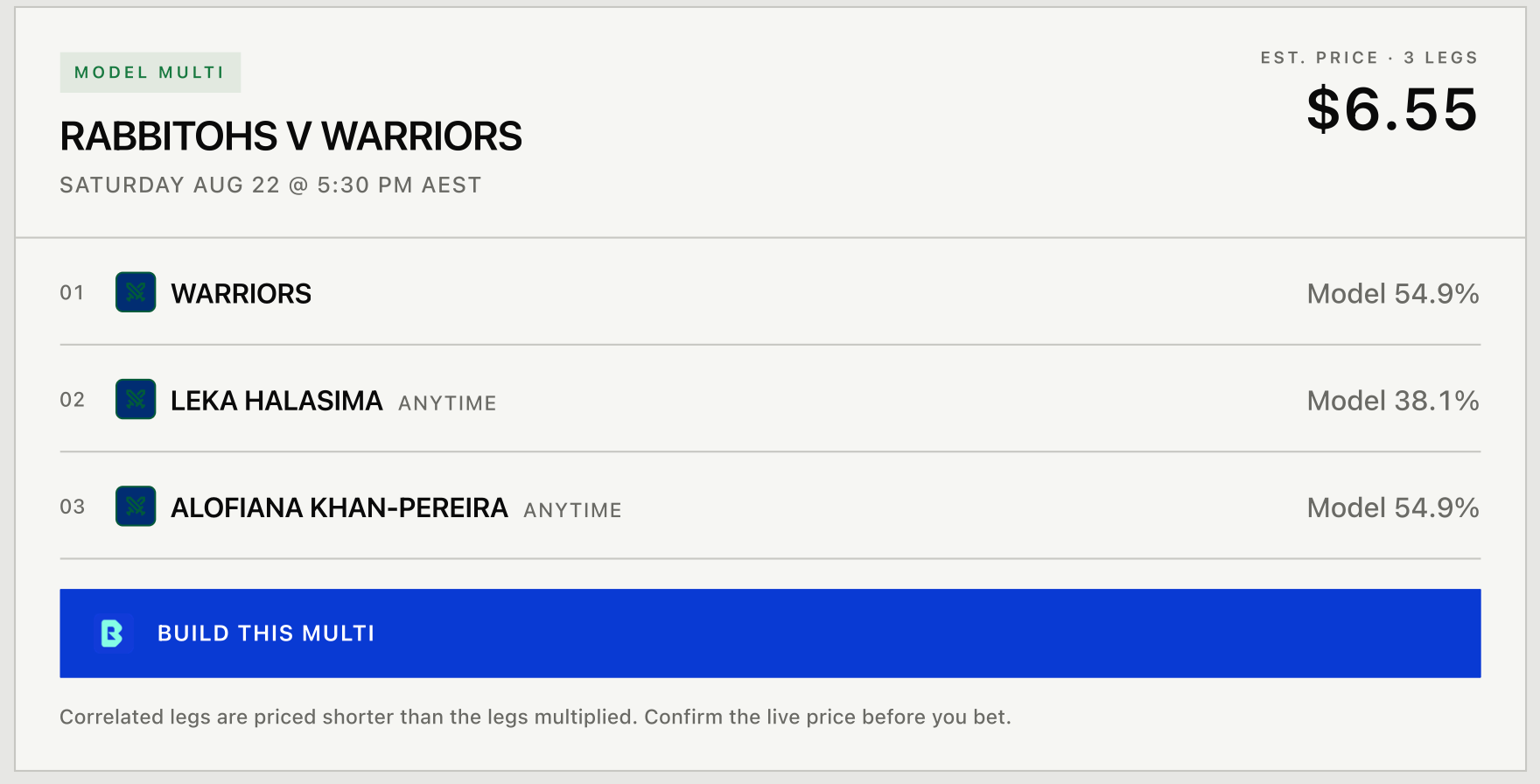
Rabbitohs v Warriors — $6.55 est. Warriors (model 54.9%), Leka Halasima anytime (38.1%), Alofiana Khan-Pereira anytime (54.9%). Warriors 45, Rabbitohs 26. All three legs landed.
The model read: Close, and the model said so — 54.9% is barely a lean. Souths had the better home record and actually lead the competition for line breaks at 6.6 a game. What tipped it was the road split: the Warriors have won seven of eleven away from home with a points difference of +156 on the road, behind the second-stingiest defence in the competition at 15.71 conceded per game.
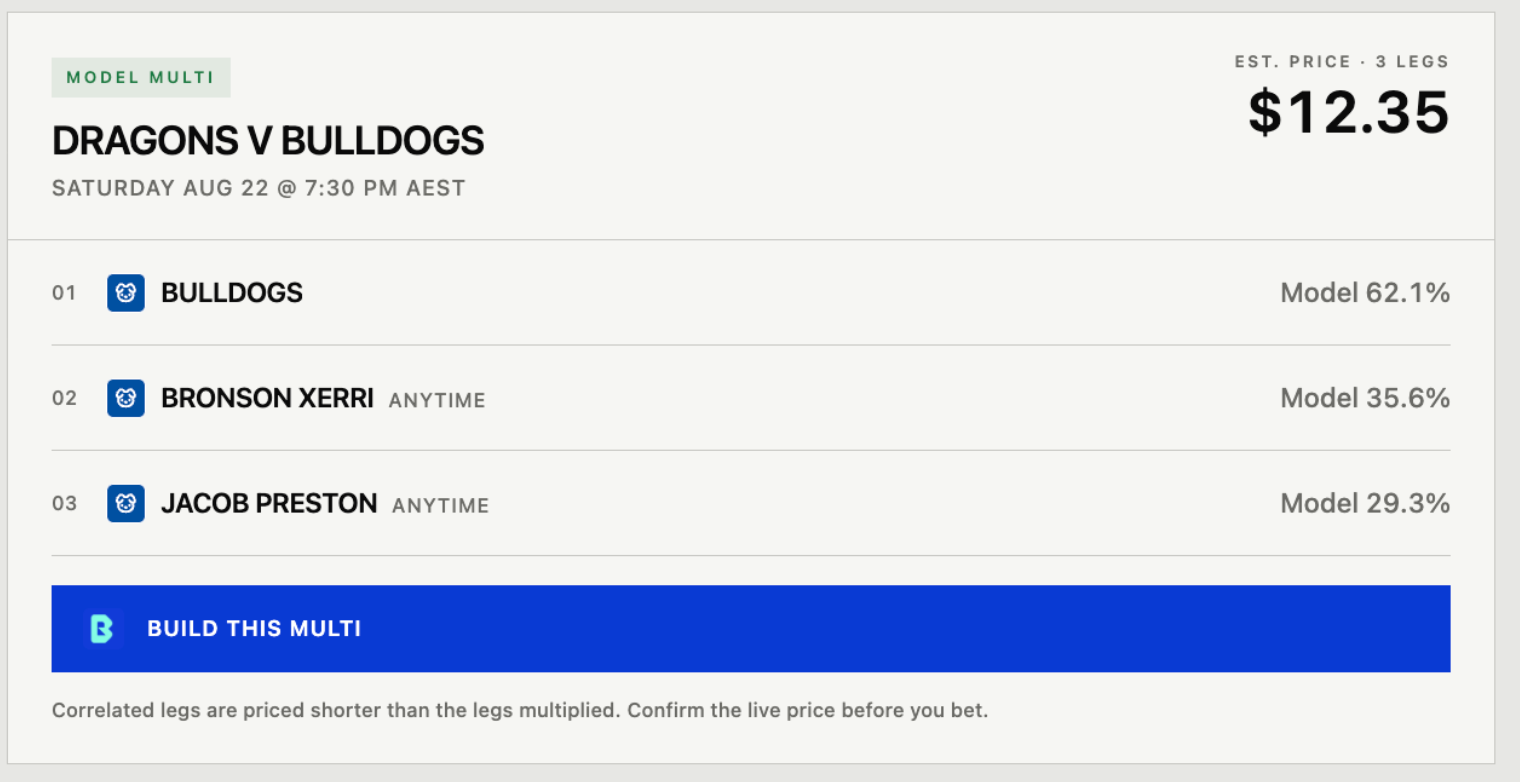
Dragons v Bulldogs — $12.35 est. Bulldogs (model 62.1%), Bronson Xerri anytime (35.6%), Jacob Preston anytime (29.3%). Bulldogs 44, Dragons 14. All three legs landed.
The model read: Canterbury aren't a high-scoring side — 19.14 points a game, bottom third. But they generate: 569.1 post-contact metres and 32.9 tackle breaks a round. St George Illawarra concede 28.9 a game, second-most in the competition. The read wasn't that the Bulldogs are great. It was that the yardage was going to convert against that defence.
Three from three is a good weekend. It isn't proof, and we'll say so before anyone else does — because knowing what a sample of three is worth is the same skill as knowing what a 29.3% leg is worth.
Jacob Preston misses roughly seven times in ten. That number was on the multi before kickoff. It's not a caveat added afterwards, it's the reason the price was $12.35 and not $3. A round where all three land is a good round. A round where two of them don't is a normal one.
Every multi we publish gets reported the same way, landed or not. Anyone showing you an unbroken run is editing.
What Round 25 demonstrates is the method. Nine matches, three qualified, three times the projected script is the one that got played: the anchor side won, and the tries came from where the model said the yardage was going.
Free shows the read. Premium shows the build.
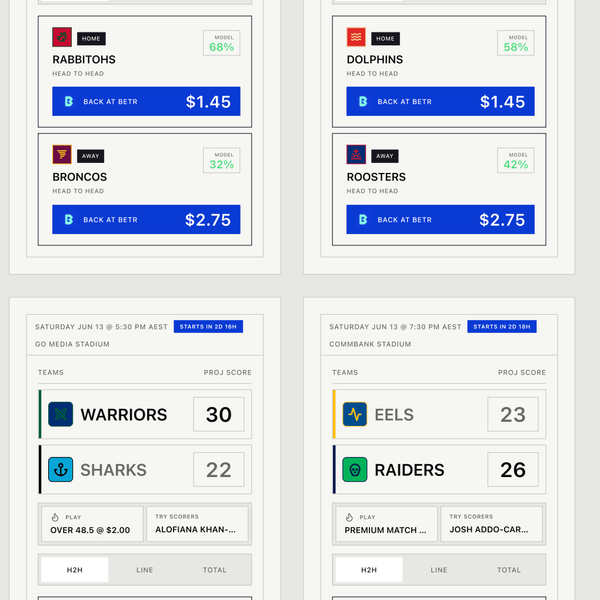
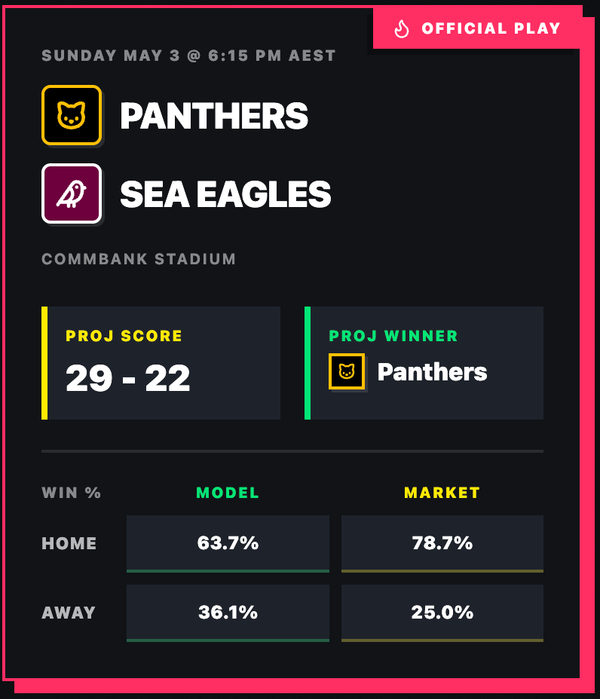
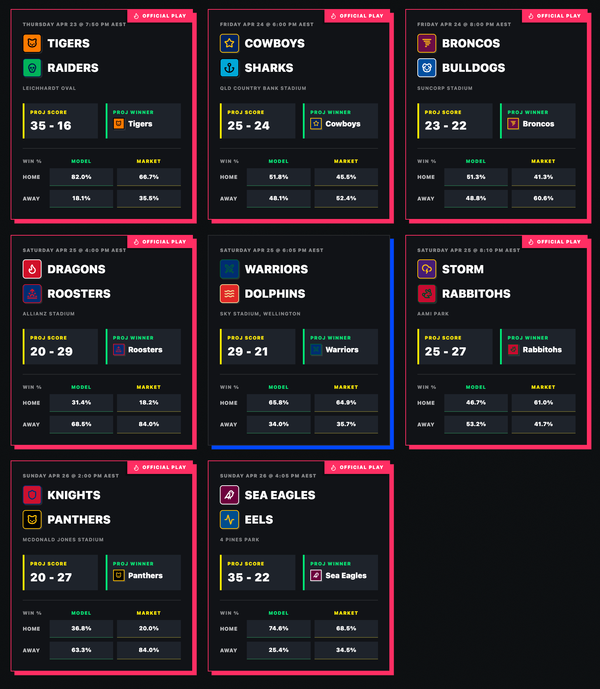
Free gets you the model's projected score for every game of the round. That's the read.
Premium gets you the constructed multis — which matches qualified, which legs, the model's number against each one, and the estimated price. That's the build.
Round 26 multis go up before the first kickoff.
RightEdge is an independent analytics tool and is not affiliated with, endorsed by, or licensed by the National Rugby League or its clubs. Model outputs are probability estimates, not certainties.
What's gambling really costing you? For free and confidential support call 1800 858 858 or visit gamblinghelponline.org.au. 18+ only.